
Tap Handle #354: Crispin - Original Super Premium Hard Cider
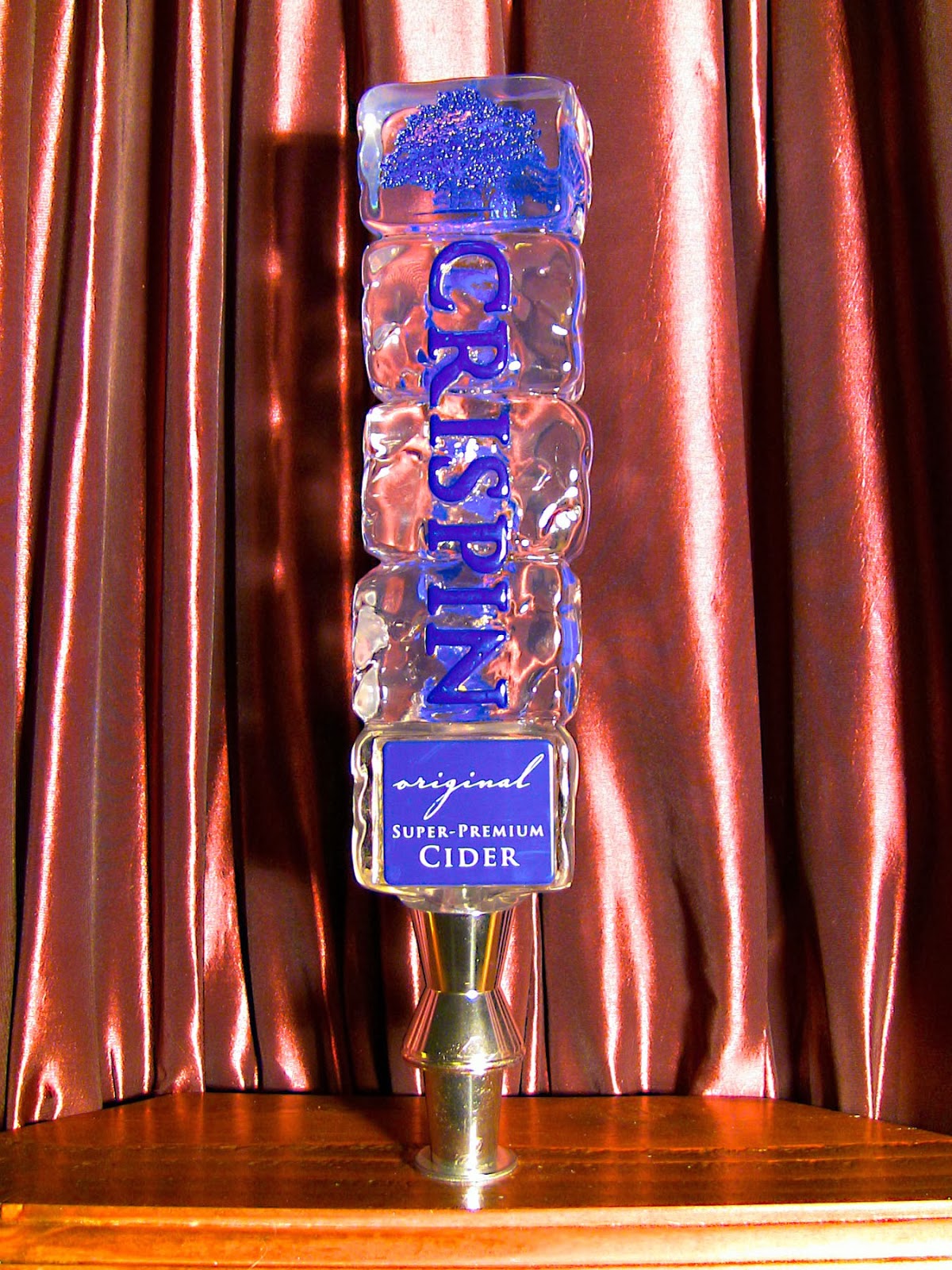
Tap size: 10.25"
Rarity: readily available
Mounting: custom ferrule with 3/8" threads
Mounting: custom ferrule with 3/8" threads
I'd seen this tap for a few years but never acquired it, because there was always something else I wanted more. However, when I received it as part of a group purchase, that worked out pretty well. It's basically a bunch of ice cubes stacked on top of one another, as Crispin was made to be served over ice. The front and back are almost identical to each other, with only slight sculptural differences found in the ice cubes. This is true for the sides as well. The clear acrylic ice cubes are nicely done. The tap first appeared on the secondary market around 2010-2011, and was most likely commissioned during mid-2010 when the company experienced major growth. It was later replaced with wood taps with a piece of fruit on the top, but I would guess, at a minimum, hundreds of the acrylic version were made. As a result, this tap is fairly easy to find, as well as being inexpensive - it usually sells for between $5 - $25 on the secondary market. One reason that the tap is attractive to collectors is due to the clear acrylic and blue lettering; by placing a light underneath it, the resulting lighting effect is pretty nice.
(Editor's note: this post was updated in December 2025)

Crispin Cider Company was founded in Minneapolis, Minnesota, on October 25, 2008 (St. Crispin's Day) by Joe Heron and his wife, Lesley Heron. Joe Heron was a South African native living in Minneapolis who had started his career in advertising before joining Bristol Myers, which led to a journey across the world with his family. He lived in the United Kingdom for five years, worked for Swiss pharmaceutical company Novartis in Sweden, and was then transferred to Minneapolis to run their medical nutrition business. In 2003, while serving as Senior Vice President of Novartis Medical Nutrition, Heron and his wife Lesley founded NutriSoda, a sugar-free functional soda company. In 2006, the Herons sold NutriSoda to PepsiAmericas, the second largest Pepsi bottler in the world, after just 18 months of operation. Following this successful exit, Heron began looking for a new project and settled on hard cider.

Heron perceived a need for premium quality domestic cider in the United States market, which he believed was dominated by overly sweet products that functioned more as beer alternatives than as authentic ciders. His interest in cider developed after a friend from the United Kingdom introduced him to the concept of drinking cider over ice, a common practice in the UK that was virtually unknown in America. Heron set out to create a drier apple cider that would stay true to the original English ciders brought to the United States by the founding generation, while departing from the sweeter, modern Irish and British styles dominating the market. When exploring how to differentiate his product, many industry veterans advised Heron to buy apple wine from Canada, dilute it with spirits, and sell it as cider. Rejecting this approach as insufficiently premium, Heron instead found a small cidery in Northern California that made cider in the classic French style using pure apple juice, confirming it could be done properly.

Crispin launched in the fourth quarter of 2008 from Minneapolis, positioning itself as a super-premium hard cider brand. The company's flagship product was Crispin Original, a refreshing natural hard apple cider designed to be served over ice. The cider was fruit-forward with a fresh, crunchy apple nose and a deliciously creamy, refreshingly crisp mouthfeel. Unlike many mass market ciders, Crispin did not add sugar, artificial colorants, or sorbate and benzoate preservatives, nor did it use malt or spirit alcohols. The cider was naturally fermented using pure, fresh-pressed American apple juice (not from concentrate) from a premium blend of three to five apple varieties, mainly Granny Smith, Golden Delicious, and Washington apples. Each gallon of Crispin cider contained over 10 pounds of apples. The production process involved pressing apples at various West Coast pressing houses, then shipping the juice to begin fermentation within 36 to 48 hours.

Crispin's product line included Original, Brut, and Light varietals, as well as unfiltered Artisanal Reserve varieties such as Honey Crisp, Lansdowne, The Saint, and Cho-tokkyu (The Bohemian). The Artisanal Reserve ciders were characterized by their use of specialty yeasts, including champagne, Sake, Belgian Trappist, and Irish Ale yeasts, and were smoothed with natural sugar sources such as organic honey and organic maple syrup before being lightly carbonated. Crispin's marketing emphasized the product's wine-like qualities and deliberately crafted a brand identity that positioned it as sophisticated and premium, appealing to craft beer and wine drinkers rather than mass market beer consumers. The company grew rapidly, available in 18 states by mid-2010 with more than $5 million in sales.

In January 2010, Crispin announced the acquisition of California-based Fox Barrel Cider Company in an all-stock transaction. The acquisition included all assets and liabilities, most importantly the cidery located in Colfax, California, in the Sierra Foothills between Sacramento and Lake Tahoe. Founded by Bruce Nissen, Fox Barrel was dedicated to the production of superior pure pear ciders (perry) using fermented, unpasteurized, fresh-pressed pear juice. Fox Barrel's products were available in Pacific Pear, Blackberry Pear, and Apricot Pear varietals, as well as unfiltered Cidery Reserves including Ginger & Blackcurrant and Rhubarb & Elderberry. Fox Barrel had won multiple medals at competitions including the California State Fair, West Coast Brewers Festival, the Great Lakes Olde World Syder Competition, and the prestigious Three Counties International Cider Competition in Great Britain. Following the acquisition, Crispin relocated its headquarters and production operations to the Colfax cidery, which operated as a bonded winery. Bruce Nissen became Chief Operating Officer and head cidermaker for Crispin Cider Company.
In early 2011, Crispin began importing a dry English cider called Browns Lane (named after the original Jaguar factory in Coventry) from Tiverton, Devon, England. The company grew approximately 200 percent in 2011, significantly outpacing the overall cider category's 26 percent growth during the same period. By 2012, Crispin had become the third-largest producer of cider in the United States, with production reaching roughly 300,000 cases in 2011. The cider category was receiving substantial attention as potentially "the next craft beer," with many craft brewers adding cider lines to complement their beer offerings. Jim Koch of Boston Beer Company had launched Angry Orchard in 2011, and major beverage companies were taking notice of the rapidly expanding category.
In February 2012, MillerCoors' craft and import division, Tenth and Blake Beer Company, acquired Crispin Cider Company in an undisclosed transaction. The purchase included Crispin's affiliate, Fox Barrel Cider Company. This was founder Joe Heron's second successful sale in the beverage category, following the 2006 sale of NutriSoda to PepsiAmericas. Tenth and Blake President and CEO Tom Cardella explained that as they explored participation in the exploding cider category, Crispin stood out not only as the most progressive and innovative producer but also because of strong personal chemistry between the companies. Crispin continued to operate as an independent division of Tenth and Blake, with all production remaining at the Colfax cidery and the company maintaining its own unique go-to-market execution. Heron remained involved with the company initially, though he and Lesley would go on to found Copper & Kings American Brandy in Louisville, Kentucky, in 2014.
Under MillerCoors ownership, Crispin continued to expand its product line and distribution. The company introduced new varieties including Crispin Rosé and maintained its reputation for innovation and quality. Crispin ciders were produced using fresh-pressed, unpasteurized pure apple juice sourced from the Pacific Northwest, with no preservatives, added malt, distilled spirits, or grape alcohol. The ciders were naturally gluten-free and held to the highest standards. Through classic cold fermentation and specially selected wine yeasts, Crispin stayed true to the fruit with authentic flavors and unique aromatic notes. The company positioned itself as a premium alternative to mass market ciders, appealing to a sophisticated consumer base that appreciated craft quality.
However, as the cider market evolved over the following decade, Crispin faced increasing competition from both national brands like Angry Orchard and a new wave of regional craft cideries. The national cider market began to struggle while regional and local cider brands thrived, growing at more than triple the rate of national brands in 2020. Off-premise dollar sales of Crispin's top three SKUs—its variety pack, rosé, and original offerings—declined by 79.3 percent, 87.5 percent, and 55 percent respectively for the 52-week period ending March 21, 2021. In April 2021, amid significant downturns in sales, Molson Coors Beverage Company (the successor to MillerCoors following corporate restructuring) discontinued the Crispin brand along with Smith & Forge, another hard cider brand in its portfolio. The Colfax cidery was closed, and production of all Crispin products ceased.
The brand remained dormant for approximately two years until Minneapolis Cider Company, founded in 2015 by University of Minnesota students Jason Dayton and David O'Neill, approached Molson Coors about reviving the brand. Dayton and O'Neill had launched their company as a senior project called Lionheart, rebranding as Minneapolis Cider Company in 2017, and had been mentored early on by Joe Heron and Bruce Nissen. When they started in the cider industry, it was Crispin's founder and former head cidermaker who had helped put them on the path to success. The founders saw an opportunity to bring back a beloved brand that was fondly remembered by cider drinkers as one of the first craft cider brands many had tried. In January 2023, Minneapolis Cider Company finalized a licensing agreement with Molson Coors that gave them control over all aspects of day-to-day brand management, new product innovation, production, and sales.
Crispin relaunched in October 2023 with three ciders: Crispin Original (the classic 5 percent ABV cider made from fresh-pressed apples), Crispin Imperial (a new 8 percent ABV cider crafted with European bittersweet apples), and Crispin Mango Mimosa (an 8 percent ABV tropical-flavored imperial cider). The relaunch initially focused on Minnesota, Wisconsin, North Dakota, and South Dakota, with plans to expand nationally over the following two years and eventually launch in the United Kingdom for the first time. The first batch of the relaunched Crispin Original was entrusted to Bruce Nissen, who had been the original head cidermaker. As of 2025, Crispin continues production under Minneapolis Cider Company's management, with distribution expanding across the United States while maintaining the brand's commitment to quality and innovation.
Crispin Original is a refreshing natural hard apple cider crafted to be served over ice. A classically styled but untraditional hard apple cider, it is fruit-forward with a fresh, crunchy apple nose and a deliciously creamy, refreshingly crisp mouthfeel. The cider features a balance between sweetness and dryness, making it neither too sweet nor too dry. Naturally fermented using fresh-pressed apple juice from a premium blend of apples (mainly Granny Smith, Golden Delicious, and Washington varieties), Crispin Original contains no added malt, grape wine, or spirit alcohol, and is naturally gluten-free. The cider is smoothed with pure apple juice, contains no added colorants or preservatives, and is filtered cold for crisp refreshment. Recommended food pairings include spicy foods, where the cider's balance works similarly to a dry Riesling or Gewürztraminer, not being overpowered by strong flavors.
Ratebeer: 2.88 out of 5
Untappd: 3.48 out of 5
Source Material
Comments
Post a Comment